

A reproducible fine-tune with the measurement in plain sight: Vietnamese diacritics with CANINE-s
A portfolio test of our own, not client work. Public data (Vietnamese Wikipedia), a model under an open licence, and code in a repository you can run yourself.
The problem
Anyone who wants to commission a fine-tune has a fair question: "show me a repository where you fine-tuned a model and measured something". Not a demo, but something you can clone, run and check. This is ours: a small fine-tune with the before/after measurement, the simple baselines it has to be compared against, and a section on what did not work.
What we did
The task. Restore Vietnamese diacritics: a sentence goes in with every mark stripped (đ becomes d) and the correct sentence comes out. We used CANINE-s (Google, about 0.13B parameters, character-level, no token vocabulary) with a classification head that predicts, for each character, which marks it carries (36 labels, one of them "none"). The text is rebuilt by composing each input character with its predicted marks, so the model cannot change a base letter: an assertion checks this on every test sentence (0 changes).
- Why Vietnamese and not Arabic. The standard Arabic diacritization corpus, Tashkeela, is GPL-2.0, and its re-uploads labelled MIT or Apache-2.0 are of unverified provenance (we did not check). The task has the same shape (restore marks on letters), so we used a corpus whose licence we could read at the source. Nothing has been run on Arabic.
- One command.
./run.shcreates the environment with pinned versions, downloads data and model, builds the splits, trains, evaluates and writesresults.mdandresults.json. It needs Linux, an NVIDIA GPU,uvand about 0.8 GB of downloads. - Split by article, no leakage. Each sentence goes to test, validation or training according to the SHA-1 hash of its article title, so one article is never in two parts. Exact duplicates are removed and an assertion checks that no training sentence appears in test. We used 400,000 training sentences, 2,000 validation and 5,000 test (2,314 articles).
- Simple baselines. A fine-tune only means something against something. We measured copying the input and a lookup of the most frequent form of each syllable seen in training (the baseline that matters), plus the model before fine-tuning.
- Confidence intervals. Sentence-level bootstrap, 1,000 resamples.
What we measured
| System | Syllable accuracy | Syllable 95 % CI | Letter accuracy | Whole sentence right |
|---|---|---|---|---|
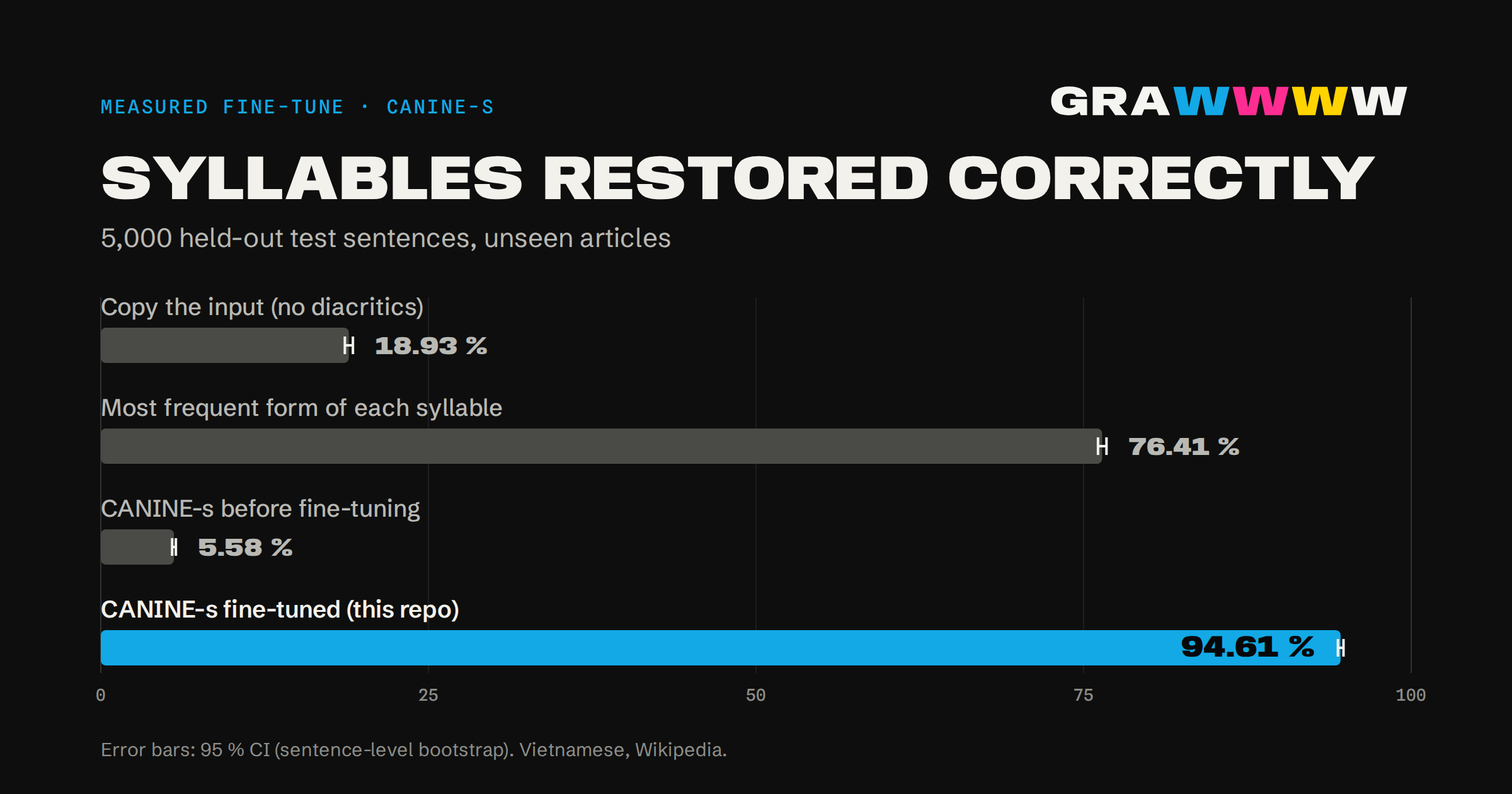
| Copy the input (no diacritics) | 18.93 % | 18.63–19.24 | 74.05 % | 0.00 % |
| Baseline: most frequent form of each syllable seen in training | 76.41 % | 76.10–76.75 | 93.09 % | 4.44 % |
| CANINE-s before fine-tuning (random head) | 5.58 % | 5.44–5.73 | 55.32 % | 0.00 % |
| CANINE-s fine-tuned (this repository) | 94.61 % | 94.41–94.83 | 98.41 % | 47.96 % |
Syllables are whitespace-separated tokens with punctuation stripped, and count only if they match the original exactly. Letter accuracy includes the many letters that carry no mark, which is why "copy the input" is not zero. The syllable error rate goes from 23.59 % with the frequent-form lookup to 5.39 %.
The "before fine-tuning" row is the pretrained encoder with a randomly initialised head. It shows the task is not solved by the pretrained model alone, but it is not a strong baseline: the lookup is the one that counts.
Rerun. We ran the whole pipeline twice from the same pinned environment. The three data files came out byte-identical (sha256). The model results did not: 94.58 % the first time and 94.61 % the second, because GPU kernels are not run in deterministic mode. Expect differences of a few hundredths of a point between reruns.
What it costs: GPU and VRAM
| Item | Value |
|---|---|
| GPU | NVIDIA RTX 4090 (shared with other jobs; only our process counted for VRAM) |
| Training | 18,750 steps, batch 64, 3 epochs over 400,000 sentences, lr 5e-5, bf16 |
| Training time | 19.5 min |
| GPU, train + eval (incl. model loading) | 0.34 GPU-hours (20.3 min) |
| Peak VRAM, training (allocated / reserved) | 4.72 / 5.87 GB |
| Peak VRAM, inference on the test set | 1.95 GB |
| Inference speed | 5,990 sentences/s (batch 128) |
| Data preparation (CPU) | 812 s |
| Whole pipeline (`run.sh`) | 33.8 min |
Estimated cost if the same card were rented, at RunPod's public list prices read from https://www.runpod.io/pricing on 2026-10-16 (the page was marked as updated 2026-10-08): RTX 4090, Community Cloud $0.34/h, Secure Cloud $0.89/h.
| Scope | Hours | Community | Secure |
|---|---|---|---|
| GPU time only | 0.34 h | $0.11 | $0.30 |
| Whole pipeline, incl. data | 0.56 h | $0.19 | $0.50 |
An estimate, not an invoice: prices change. We ran it on our own card and paid nothing for GPU time.
Error examples
Examples from the test set, with the Wikipedia article title. The input is the original sentence with its marks removed. Syllables that differ from the original are highlighted in pink. These are the first three of each list from a seeded shuffle, not selected.
Model right, baseline wrong
Article: Wilhelm II, Hoàng đế Đức
- Input (no marks)
- Voi tinh khi khac thuong, ong thuong noi the nay nhung lai lam the khac.
- Original
- Với tính khí khác thường, ông thường nói thế này nhưng lại làm thế khác.
- Baseline (frequent forms)
- Với tỉnh khi khác thường, ông thường nơi thể này những lại làm thể khác.
- Fine-tuned model
- Với tính khí khác thường, ông thường nói thế này nhưng lại làm thế khác.
Article: Darin
- Input (no marks)
- Exit bao gom cac bai hat "Nobody Knows", "Playing With Fire", "Check You Out" va "Before I Pass Out", voi phan sau chua cac tinh nang cua rapper Lil Jon.
- Original
- Exit bao gồm các bài hát "Nobody Knows", "Playing With Fire", "Check You Out" và "Before I Pass Out", với phần sau chứa các tính năng của rapper Lil Jon.
- Baseline (frequent forms)
- Exit bao gồm các bài hát "Nobody Knows", "Playing With Fire", "Check You Out" và "Before I Pass Out", với phần sau chưa các tỉnh năng của rapper Lil Jon.
- Fine-tuned model
- Exit bao gồm các bài hát "Nobody Knows", "Playing With Fire", "Check You Out" và "Before I Pass Out", với phần sau chứa các tính năng của rapper Lil Jon.
Article: Thổ Nhĩ Kỳ
- Input (no marks)
- Tai tay bac Tho Nhi Ky, nhom bo toc quan trong nhat tai Thrace la Odyrisia.
- Original
- Tại tây bắc Thổ Nhĩ Kỳ, nhóm bộ tộc quan trọng nhất tại Thrace là Odyrisia.
- Baseline (frequent forms)
- Tại tây bắc Thổ Nhĩ Kỳ, nhóm bộ tộc quân trong nhất tại Thrace là Odyrisia.
- Fine-tuned model
- Tại tây bắc Thổ Nhĩ Kỳ, nhóm bộ tộc quan trọng nhất tại Thrace là Odyrisia.
Model wrong
Article: Gia phả
- Input (no marks)
- O Tay phuong, nguoi ta co tap tuc lam cay pha he hay pha do, tuong tu nhu Tong do cua nguoi Hoa hay nguoi Viet.
- Original
- Ở Tây phương, người ta có tập tục làm cây phả hệ hay phả đồ, tương tự như Tông đồ của người Hoa hay người Việt.
- Baseline (frequent forms)
- Ở Tây phương, người ta có tập tục làm cây phá hệ hay phá đó, tướng từ như Tổng đó của người Hoa hay người Việt.
- Fine-tuned model
- Ở Tây phương, người ta có tập tục làm cây phà hệ hay phá đỡ, tương tự như Tông đồ của người Hoa hay người Việt.
Article: Chùa Shwedagon
- Input (no marks)
- Stupa (phu do) tung bi hu hai suot mot thoi gian dai va duoc Vua Binnya U cua Hanthawaddy sua lai.
- Original
- Stupa (phù đồ) từng bị hư hại suốt một thời gian dài và được Vua Binnya U của Hanthawaddy sửa lại.
- Baseline (frequent forms)
- Stupa (phủ đó) từng bị hư hai suốt một thời gian đại và được Vua Binnya U của Hanthawaddy sửa lại.
- Fine-tuned model
- Stupa (phụ đó) từng bị hư hại suốt một thời gian dài và được Vua Binnya U của Hanthawaddy sửa lại.
Article: Adolf Hitler
- Input (no marks)
- Trong thoi gian xay ra cuoc khung hoang, Hitler tu bo nhiem minh lam nguoi dung dau Oberkommando des Heeres (Bo Tong tu lenh Luc quan).
- Original
- Trong thời gian xảy ra cuộc khủng hoảng, Hitler tự bổ nhiệm mình làm người đứng đầu Oberkommando des Heeres (Bộ Tổng tư lệnh Lục quân).
- Baseline (frequent forms)
- Trong thời gian xây ra cuộc khủng hoàng, Hitler từ bộ nhiệm mình làm người dụng đầu Oberkommando des Heeres (Bộ Tổng từ lệnh Lục quân).
- Fine-tuned model
- Trong thời gian xảy ra cuộc khủng hoảng, Hitler từ bổ nhiệm mình làm người đứng đầu Oberkommando des Heeres (Bộ Tổng tư lệnh Lục quân).
The most frequent error pairs are swaps between valid words: loại/loài, từ/tự, con/còn, cùng/cũng, quan/quân, cổ/có.
What still fails and what we did not measure
- Sentence-level success is modest. Under half of the test sentences (47.96 %) come out exactly right; 5.4 % of syllables are wrong, so a typical 22-syllable sentence has about one error (110,862 syllables over 5,000 sentences).
- Ambiguity the model cannot resolve from a sentence. Some pairs are genuinely ambiguous without wider context, and the model sees one sentence at a time.
- Spelling conventions are label noise. Wikipedia mixes
hoá/hóaandHoà/Hòa(tone mark placement). The model can only guess which style an article uses; here these count as errors. - Names and foreign words. Those with no marks pass through unchanged; rare Sino-Vietnamese names are often wrong.
- Mistakes made on the way. The first training attempt crashed in validation because an impossible mark combination changed the string length (the base-letter assertion caught it; fixed). The first evaluation crashed because a torch native kernel needed a C compiler. In the first full run,
make_results.pyfailed on a malformed number intiming.json, which was corrected by hand for that run only; the published run'stiming.jsonwas written by the fixed script. No logs of those failed attempts were kept, except the 1-epoch preliminary run. - Not measured: variance across training seeds (one seed per run, two runs total); other learning rates or batch sizes; larger models or more data (validation still rose slowly at the end, 94.94 % to 95.21 % over the last 3,000 steps); text outside Wikipedia (news, chat, OCR); sentences longer than 200 characters; comparison with published Vietnamese systems (our split and filtering differ, so numbers are not comparable); CPU inference speed; any language other than Vietnamese. The test sentences have at least 5 diacritised letters, so scores on text with few marks may differ.
- Peak VRAM is the PyTorch allocator peak of our process on a card shared with other jobs; GPU time is the wall time of the train and eval steps including model loading.
What a client gets
The same thing you see here, applied to your data: a model fine-tuned for a product, character, style or task, a repository or folder you can run again, the simple baselines it is compared against, the measurement on your real cases before we hand it over, and an honest list of what fails and what we have not measured.
Custom models: from €450, excl. VAT. It is a starting price: after the first conversation, the proposal fixes scope and price. Details on the Technical teams page, or write to hello@grawwww.xyz. We answer in under 48 hours.
Credits and licences
- Model:
google/canine-s(CANINE-s), Apache-2.0. - Data: Vietnamese Wikipedia (2023-11-01 dump as published by Wikimedia on Hugging Face), CC BY-SA and GFDL. The text excerpts on this page are from Wikipedia, with the article title; authors are listed in each article's history. We do not redistribute the corpus or any trained weights.
- Our code, README and results: MIT licence.
- If you retrain and publish weights, read the CC BY-SA terms first. We have not taken legal advice on whether weights are derivative works, and we publish none.